
Succession Fact #1: Capital and Cash Flow
 D. Brown Management
November 28, 2018
D. Brown Management
November 28, 2018
Succession Fact #1: No deal structure will substantially create capital or cash flow. It is only the business performance that ensures all major stakeholder groups are compensated properly for their time and capital put at risk.
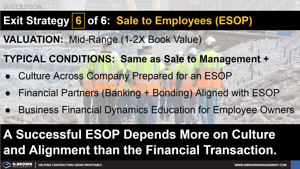
Contractor Exit Strategy 6 of 6: Sale to Employees (ESOP)
D. Brown Management
November 27, 2018
Contractor Exit Strategy 6 of 6: An ESOP (Employee Stock Ownership Plan) is a qualified defined contribution employee benefit plan designed primarily to invest in the company’s stock.
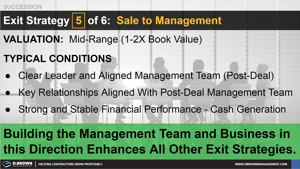
Contractor Exit Strategy 5 of 6: Sale to Management
D. Brown Management
November 26, 2018
Contractor Exit Strategy 5 of 6: Sale to Management. A very common exit strategy for contractors and one that might be integrated with passing the business down to family or used when there is no family involved in the management of the company.

Contractor Exit Strategy 4 of 6: Merger with a Similar Contractor
D. Brown Management
November 25, 2018
Contractor Exit Strategy 4 of 6: Merging with a contractor that has a complementary market position and management team can be both a great exit strategy as well as an effective growth strategy.

Contractor Exit Strategy 3 of 6: Strategic Sale to an Outside Buyer
D. Brown Management
November 24, 2018
Contractor Exit Strategy 3 of 6: Strategic Sale to an Outside Buyer. This is what every contractor wants, however, only a small percentage of deals truly fit into this category.
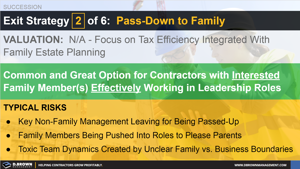
Contractor Exit Strategy 2 of 6: Pass Down to Family
D. Brown Management
November 23, 2018
Contractor Exit Strategy 2 of 6: Pass Down to Family. This is a very common strategy for contractors and is successful for those with interested family member(s) who are effectively working in leadership roles.
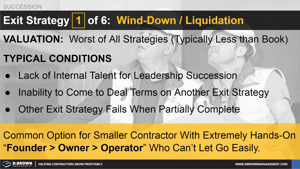
Contractor Exit Strategy 1 of 6: Winding Down or Liquidation
D. Brown Management
November 22, 2018
Contractor Exit Strategy 1 of 6: Wind-Down of the Business or Liquidation. This “exit strategy” can mostly be seen as the lack of a clear exit strategy and plan.
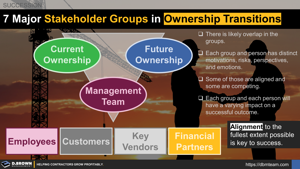
7 Major Stakeholder Groups in Ownership Transitions
D. Brown Management
November 21, 2018
As contractors plan for ownership transitions, there are seven major stakeholder groups that will sometimes have competing wants and needs that must be identified and brought into alignment.
ownership transition succession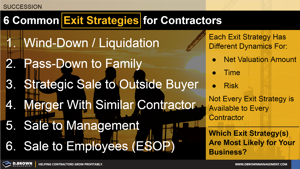
6 Common Exit Strategies for Contractors
D. Brown Management
November 20, 2018
Contracting is a capital-intensive and risky business. The construction business is also amazing, with the owners making a good return on their capital.

Accelerating Retirement & Succession
D. Brown Management
November 19, 2018
Today, succession planning is more important for contractors than any time in recent history.
