
Sometimes the new tool of the times was something a worker picked up every day, like a nail gun. Other times it worked entirely in the background as an enabler that made future tools possible rather than being the end product itself. AI is going through that same lifecycle right now, and it's worth understanding where it sits in that arc.
By now, it's hard for a week to pass without overhearing conversations about AI. The discussions are starting to become increasingly polarized, swinging between overconfidence and outright dismissal. Some still argue AI hasn't proven itself yet. Others think it's already past the tipping point. Either way, it follows a pattern that construction has seen before, and it's worth paying attention to where it lands.
Let's look at a couple of construction technologies that followed this exact pattern. They were met with skepticism, unlocked by an enabler, and ultimately adopted across the industry. In some cases, the specific technology itself was the enabler for what came next. In others, it was the final product.
Ready Mix Concrete
The history of ready-mix concrete is a clear example of a development that faced skepticism from both inside and outside the industry before transforming it entirely. From the first batch plants appearing in the United States in the 1910s to the post–World War II building boom of the 1960s, it took decades for ready-mix to become the dominant method of concrete delivery over mix-on-site practices. [1]
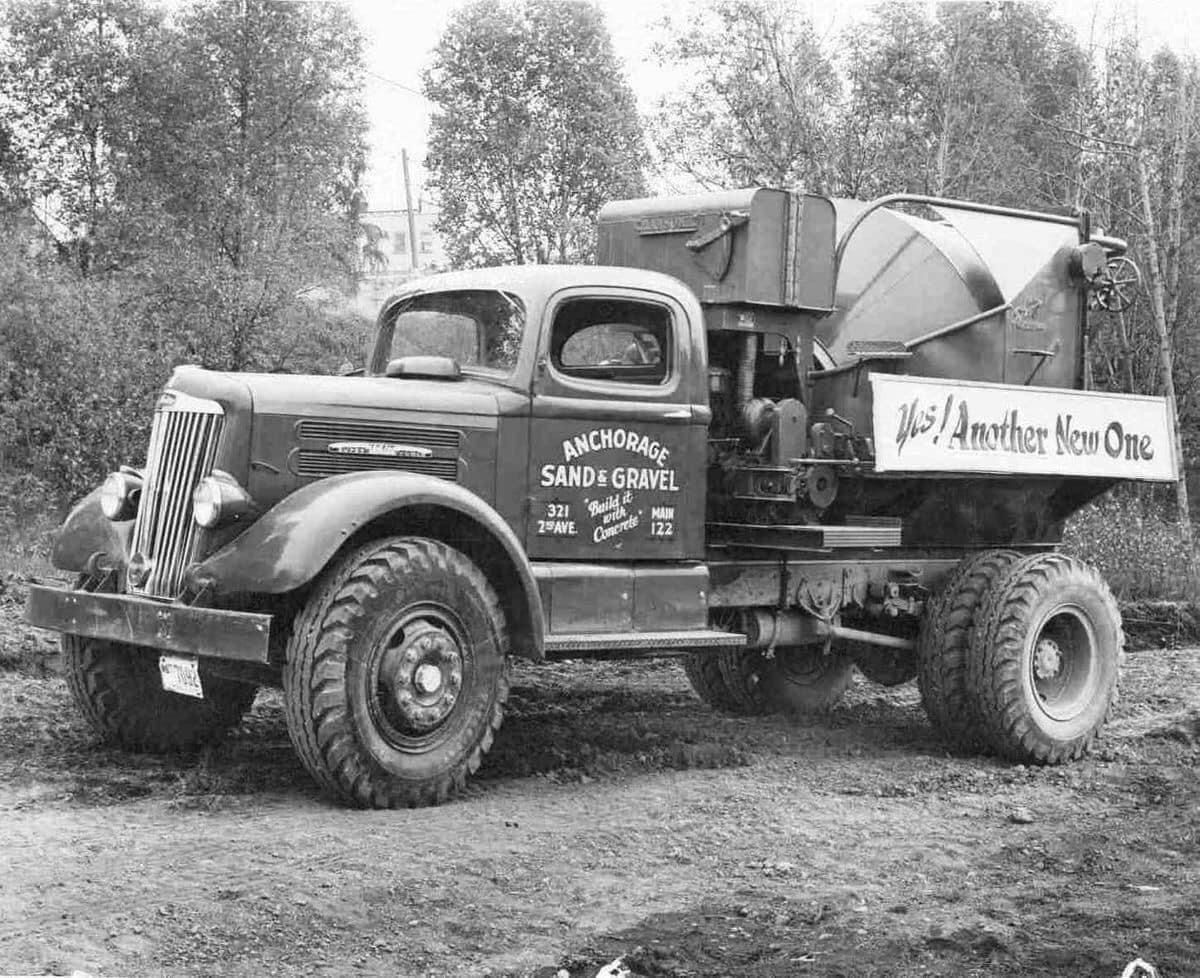
There were many arguments against it, both legitimate and spurious. The first major hurdle was logistical. There was no reliable way to transport concrete from the batch plant to the jobsite without it partially setting in transit. The breakthrough enabler was the development of the rotating drum transit mixer, the modern concrete truck, which made consistent delivery possible at-scale.
The second enabler was infrastructure. The nationwide buildout of the interstate highway system dramatically expanded delivery range and reliability. Without it, batch plants were limited to small service areas, which constrained economies of scale and customer density.
The third hurdle was trust. Contractors needed confidence that the product would consistently meet specifications and quality standards. That barrier was overcome through standards-based ordering, mix design classification, and formalized quality control processes [2].
Pneumatic Nail Guns
Nail gun implementation was one that happened “very quickly” compared to ready-mix because it didn’t have many dependencies, especially not infrastructure ones, but it challenged deeply rooted norms around craftsmanship and what it meant to “earn” productivity.
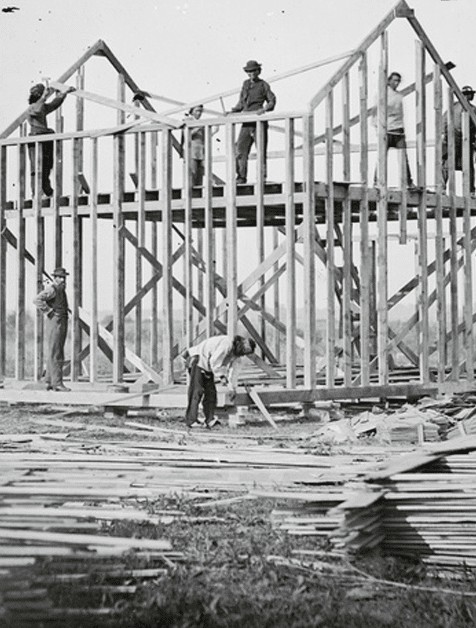
Many opponents of nail guns pushed back against their use because of perceived quality losses “real craftsmen only will use nail and hammer” or perceived safety issue “hammers don’t explode like compressors” or even rumors that machine-driven nails didn’t hold as well as hand-driven nails. There were also legitimate concerns that took some development to work past, safety interlocks reduced early nail gun accidents related to accidental discharge, weight reduction enabled longer use for more applications. The breakpoint that really turned the tide in hand-nailing vs nail guns was the building boom and housing demand after WW2 coupled with the pneumatic riveting developments in the factories building military vehicles for the war. Once standardized nail strips and more specialized nailers came on the market (framing, roofing, finish) and the labor savings and quality improvement were proven, nail guns became a universal tool used in almost every aspect of the building industry.
Back to AI
Resistance to AI is not irrational. Concerns about data security, intellectual property, quality control, workforce impact, and regulatory exposure are legitimate. Similar objections surfaced when ready-mix concrete and pneumatic nailers first appeared. The issue is not whether concerns exist. The issue is whether those concerns represent permanent barriers or temporary constraints that will be addressed through enabling developments.
AI is following the same pattern as the technologies we reviewed. An idea emerges. Early adopters experiment. Pushback follows. Enablers remove constraints. A breakpoint occurs. Adoption accelerates.
If we place AI on that curve today, it most closely resembles ready-mix concrete before infrastructure and standards fully matured. The capability is real. Early adopters are already seeing measurable gains in estimating support, documentation, data analysis, and administrative efficiency.[3] However, governance, infrastructure capacity, and operational integration are still developing. The tools work, but the environment around them is still catching up.
Consider the ready-mix comparison. Concrete could not scale until the transit mixer was developed and road infrastructure allowed reliable delivery over distance. AI faces a comparable constraint today. Large-scale deployment depends on computing power, specialized chips, datacenter capacity, and power infrastructure.[4][5] Demand currently exceeds supply. Those constraints are being addressed, but they have not yet disappeared. Notably, the construction industry itself is building much of the data center and energy infrastructure that will eventually remove this bottleneck.
Infrastructure and skill constraints remain real. Yet AI has already gained a foothold in many organizations and is functioning today as both a tool and an enabler.
AI as a Tool and an Enabler
Much of the public conversation frames AI as a direct production tool: drafting content, generating research, analyzing information, or automating repetitive administrative work. Those use cases are real and expanding. But in construction, the larger long-term impact may come from AI operating in the background, making existing systems more capable rather than replacing them outright.
That shift is already underway. Estimators are using AI-assisted tools to review quantities on plan sets. Project teams are relying on transcription and summarization tools to capture meeting decisions and action items. Built-in AI features within platforms such as Excel, Word, and Outlook are helping users access advanced functionality without formal training. Instead of searching documentation or external resources, users are interacting directly with their tools. The software is becoming more responsive and instructive. That is an enabling function.
Ready-mix concrete did not replace the laborer or the finisher. Nail guns did not eliminate the carpenter. Those technologies changed how work was executed, increased throughput, and improved consistency. The firms that adopted them early did not abandon craftsmanship. They expanded capacity.
AI is positioned similarly. It will not replace leadership, judgment, or relationships. It will reshape workflows and expectations around productivity. Leaders who begin structured experimentation now, with defined guardrails and clear objectives, will build organizational capability ahead of normalization.
The question is not whether AI will become part of daily operations. The question is whether your organization will approach that transition deliberately or react to it after competitors have already adapted.
In the next article, we examine how these systems function and how leaders can build the discipline required to turn AI from novelty into operational leverage.
References & Resources
[1] Agg-Net, “The Dawn of the Ready-Mixed Concrete Industry.”
https://www.agg-net.com/resources/articles/concrete/the-dawn-of-the-ready-mixed-concrete-industry
[2] Concrete Network, “Timeline of Concrete & Cement History,” ready-mix concrete entry.
https://www.concretenetwork.com/concrete-history/
[3] HBR, “AI Doesn’t Reduce Work, It Intensifies It,” Feb 2026,
https://hbr.org/2026/02/ai-doesnt-reduce-work-it-intensifies-it
[4] McKinsey & Company, “The Economic Potential of Generative AI: The Next Productivity Frontier,” Feb 2024.
https://www.mckinsey.com/capabilities/tech-and-ai/our-insights/the-economic-potential-of-generative-ai-the-next-productivity-frontier
[5] Goldman Sachs, “AI to Drive 165% Increase in Data Center Power Demand by 2030,” 2024.
https://www.goldmansachs.com/insights/articles/ai-to-drive-165-increase-in-data-center-power-demand-by-2030
