Competency and Compensation

A large part of sustainable growth for contractors is being able to effectively leverage people with a narrower set of skills to still deliver the same level of value-add to the customer.

D. Brown Management Profile Picture
Share

This support structure is called “Enabling Bureaucracy” and is a combination of management time, control systems, QA/QC, workflows, training, etc.
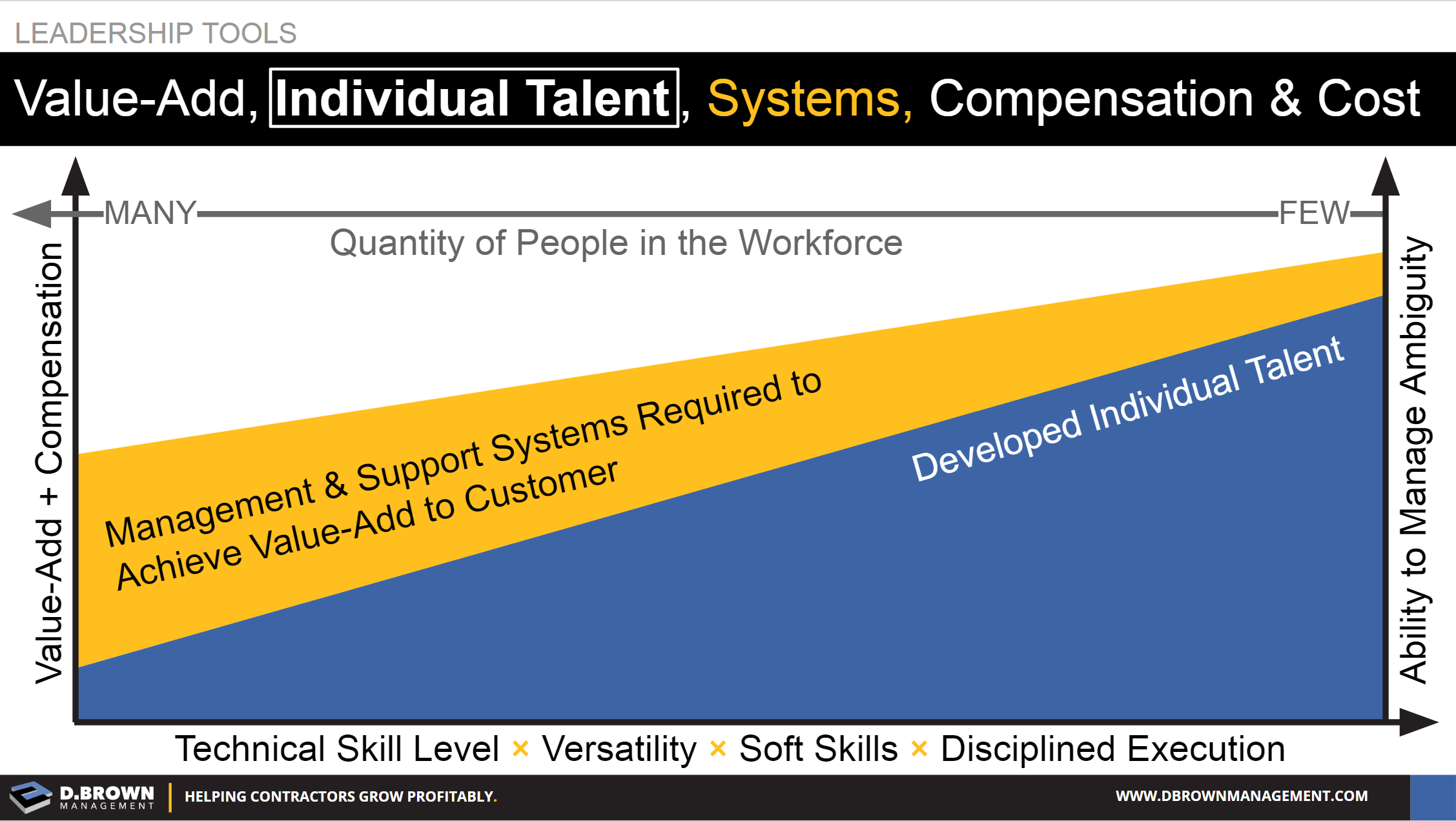
Leadership Tools: Graph representing Value-Add and Compensation with Quantity of people in the workforce, ability to manage ambiguity, and skill level and execution.

As contractors grow they need to refine their organizational structures, workflows, job descriptions  and their talent processes to support this growth.

These support structures must be built over time and integrated with the contractor’s growth strategy.  Once effectively in place these support structures will produce a more scalable organization that can actually deliver the same value-add to the customer at a lower total cost providing a competitive advantage. 

These systems are slow, painful and costly to put into place.  The recruiting focus of a contractor must be in alignment with the levels of support structures they have in place.  Netflix defines this quite well in their culture slide deck and book.  

Are your support structure capabilities and recruiting in alignment?  

If not there will be excessive stress on the team combined with lower profitability.  This just means you are at one of the inflection points on the business growth cycle.


Issue 7 of 9: Growth Strategy
Construction Ownership Transition Issue 7 of 9: In general, with all other key factors including cash flow, profitability, and customer satisfaction being equal, a contractor that is growing will be able to better handle an ownership transition.
Resource - Stratified Systems Theory (SST) and Timespan 101
All contractors navigate through very predictable stages of growth, delivering larger and more complex projects. Business complexity evolves requiring different capabilities at all levels. Tom Foster lays out some of these key differences very clearly.
Taking 100 Percent of Responsibility
Imagine having 100% control over everything. It starts by assuming 100% responsibility for everything.