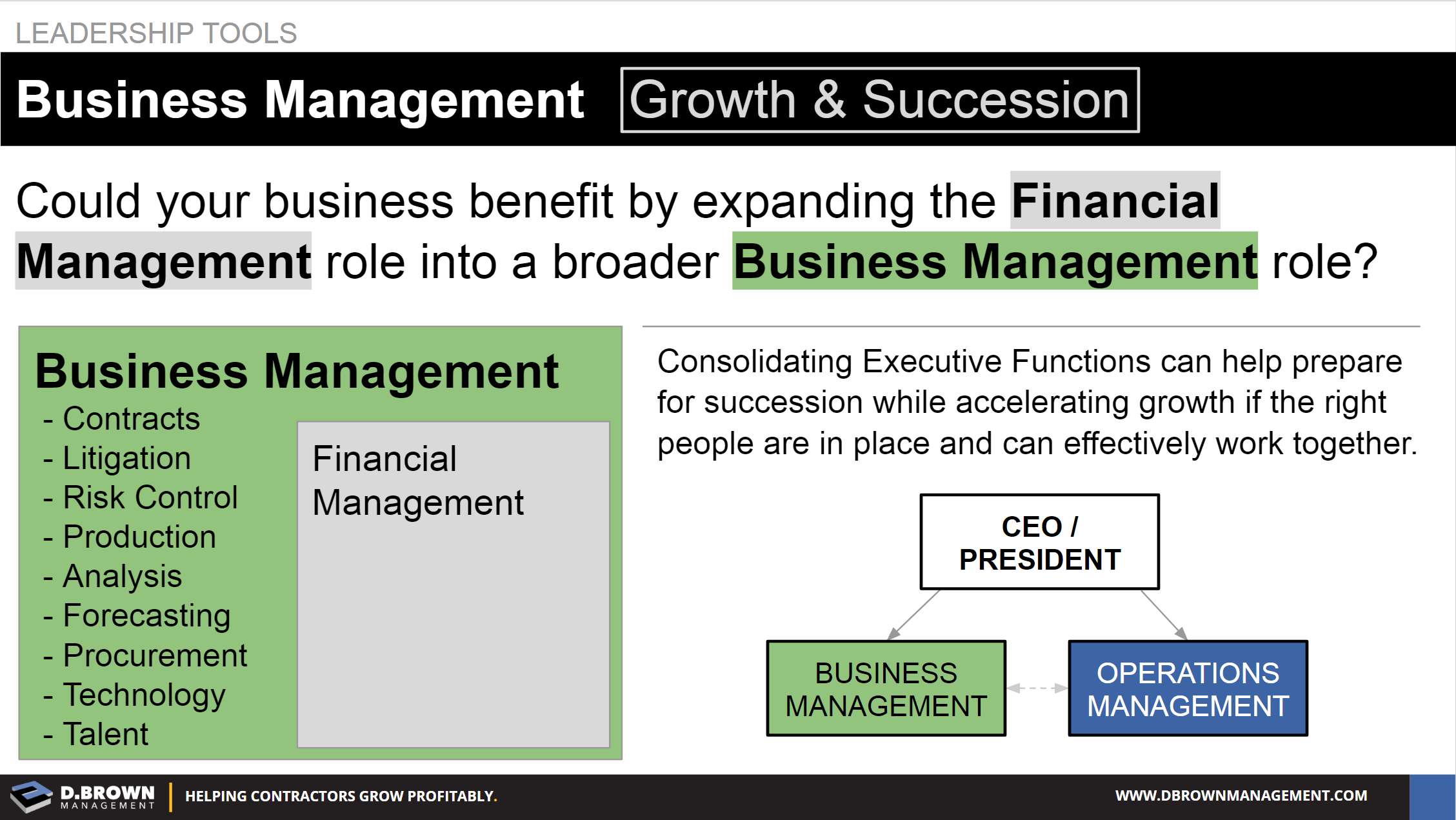
From Financial Management to Business Management

As contractors go through different stages of growth it often makes sense to expand the financial management role into more comprehensive business management role.

D. Brown Management Profile Picture
Share
Leadership Tools: Financial Management to Business Management.

At exactly what stage a contractor starts to expand this role depends on:

  1. Volume or work
  2. Complexity of work
  3. Complexity of the regulatory environment the contractor operates in
  4. Best Return on Time for other operating executives who are currently doing these functions

Of all these the best Return on Time for other executives is often the most overlooked.  Consider how much time some of these functions take other people in the organization.

Could their time be better spent:

  • Connecting with customers to help develop business?
  • Improving project execution?
  • Spending more time developing talent to build capacity for the future?

A fifth major factor includes succession - sometimes the owner/operator of the company is doing so many of these functions or managing so many direct reports that a clean succession is nearly impossible.  


Schedule a call with us to see if this makes sense for your organization


Field Productivity - The Improvement Pyramid
An improvement of a few minutes per day to actual installation time compounded monthly is worth about $800K per year for a $25M contractor. What is it worth to you? Improvements to field productivity can be viewed as 4 major stages of a pyramid.
Building a Systems Development Team - Learn More and Closing
Why is understanding the theory of constraints important to my business (and my systems development team)?
Accountability Prerequisites
Accountability in a job role is critical for contractors to grow. Accountability without clarity, capability, and capacity only leads to stress, lower performance, and higher risk over time.