
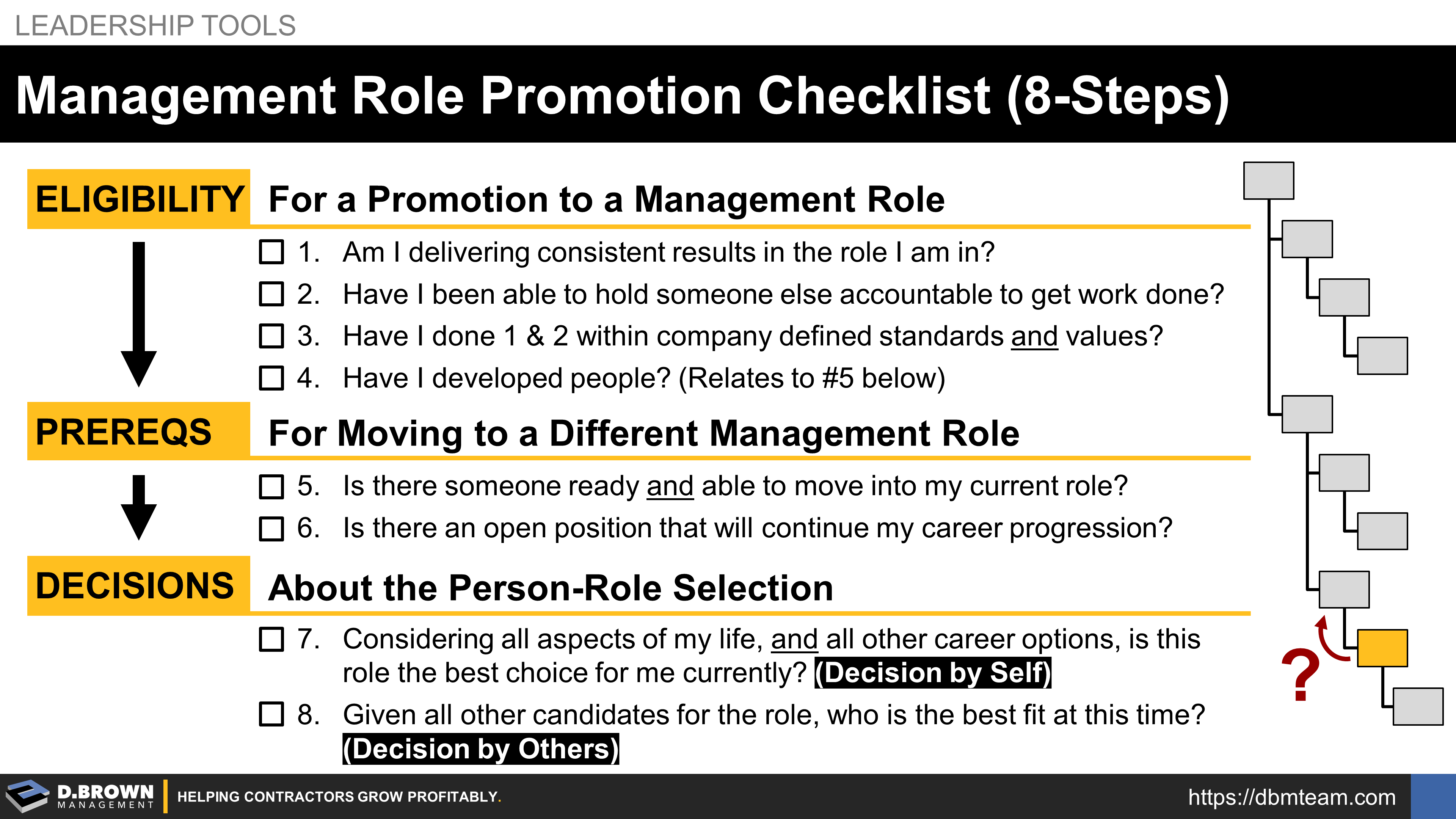
Few things will have more of an impact (positive and negative) on the team's performance than who you move into supervisory, management, and leadership roles.
Resources to Go Deeper
- Who: The A Method for Hiring (Book)
- It's the Manager: Moving from Boss to Coach (Book)
- Unicorns and the Growing Contractor (Article)
- How Wealthy Are You - The Multiple Dimensions (Article)
3 Basic Stages
- Eligibility for promotion into first-time, different, or higher-level management role.
- Prerequisites that must be true about the organization for the move to take place.
- Decisions about the selection for current best fit of person and role.
8 Basic Questions (Nuances in the Resources Above)
- Am I delivering consistent results in the role I am in?
- Have I been able to hold someone else accountable to get work done?
- Have I done 1 & 2 within company defined standards and values?
- Have I developed or improved any of the standards?
- Am I a visible role model for the positive behaviors that define our culture? (Values)
- Have I developed people? (Relates to #5 below)
- Who would identify me as key to their development?
- Is there someone ready and able to move into my current role? (Relates to #4 above)
- Is there an open position that will continue my career progression? (Relates to company growth)
- Considering all aspects of my life, and all other career options, is this role the best choice for me currently? (Decision by Self)
- Given all other candidates for the role, who is the best fit at this time? (Decision by Others)
QUESTIONS (SELF & TEAM)
- Looking at yourself, how would you answer each of these?
- What are specific next steps that would improve these, if applicable?
If you are a higher-level manager, look at the broader team you are responsible for and go through these questions for each of them.
An experienced and unbiased 3rd party can be invaluable in helping you work through these questions for your own career as well as for your team.
All relationships begin with a simple conversation - let's talk.
