Managing Dependencies and Grow Profitably

As projects and contractors grow in complexity it becomes increasingly more difficult to manage all the dependencies between tasks.

D. Brown Management Profile Picture
Share

 It is those connections between tasks and people that are often the culprit of delays rather than the actual speed of task completion itself. 
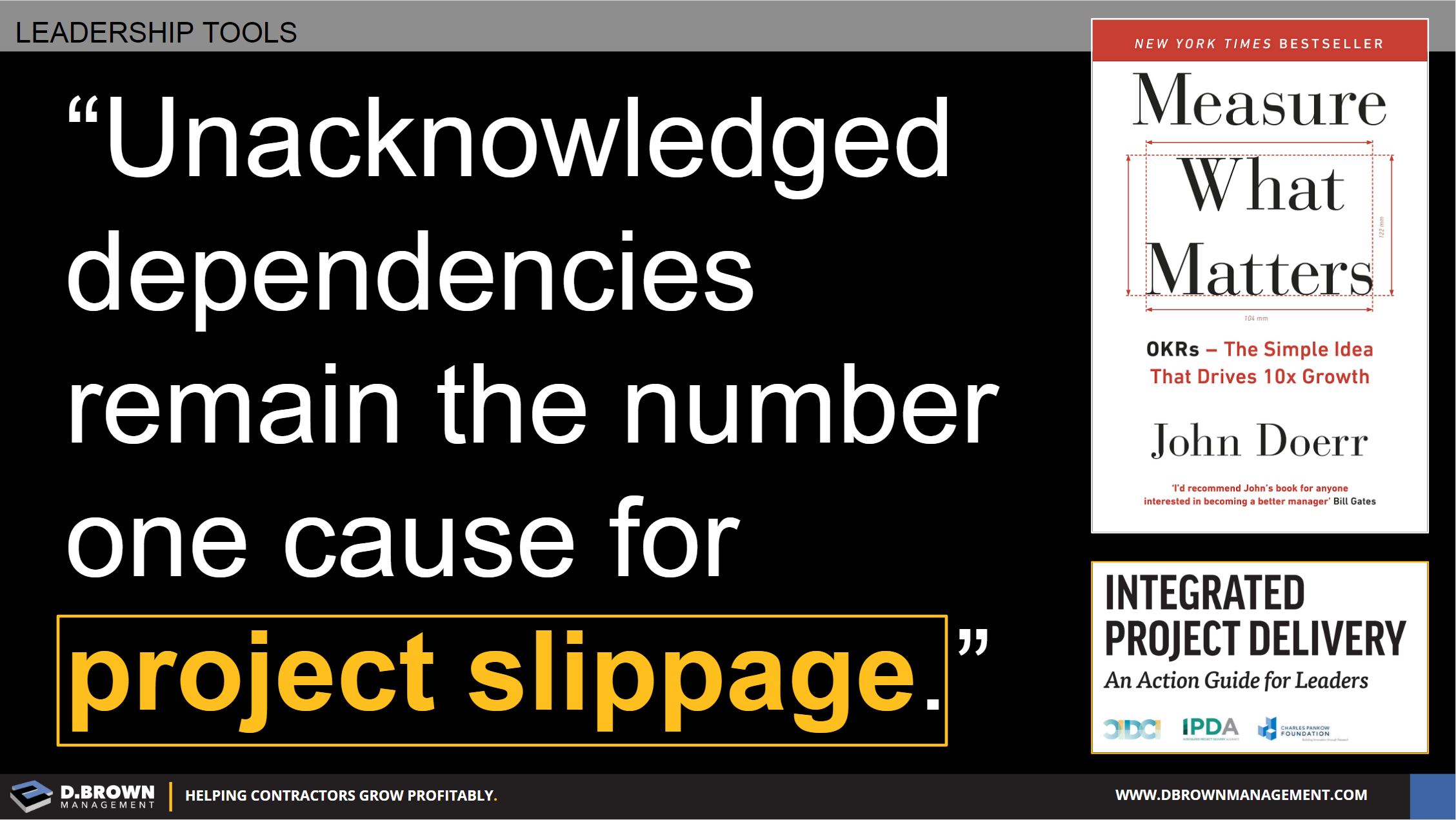
Quote: Unacknowledged dependencies remain the number one cause for project slippage. John Doerr.
  • When a business or project is simpler it can be easily managed using a task list.  
  • As it grows in complexity tools like Gantt Charts and the Critical Path Method are required for sequencing.
  • Relatively quickly you get to the point where a project or process becomes so complex that not all the dependencies can be seen by the person doing the planning and management.  
  • Even if all those dependencies could be seen by the person managing the overall project or process it is very important for the critical front-line supervisory level to deeply understand these dependencies.  

Additional tools and operating rhythms are required to develop the people that are necessary to develop the project and the company.  

Project:  The Last Planner System

Company:  Objectives & Key Results (OKR)


Learn more about how we help contractors develop the management systems required to grow their businesses profitably.


Competency and Compensation
A large part of sustainable growth for contractors is being able to effectively leverage people with a narrower set of skills to still deliver the same level of value-add to the customer.
Shifting Locus of Control
Technical skills stand on a foundation of behaviors that ultimately determine how effectively those skills are applied. Accelerating behaviors include:
Alignment and Ownership and Creating Value
As a construction company grows, it becomes increasingly important to align everyone on the team. Alignment comes from being transparent with your guiding principles or values and living them every day, starting with ownership.