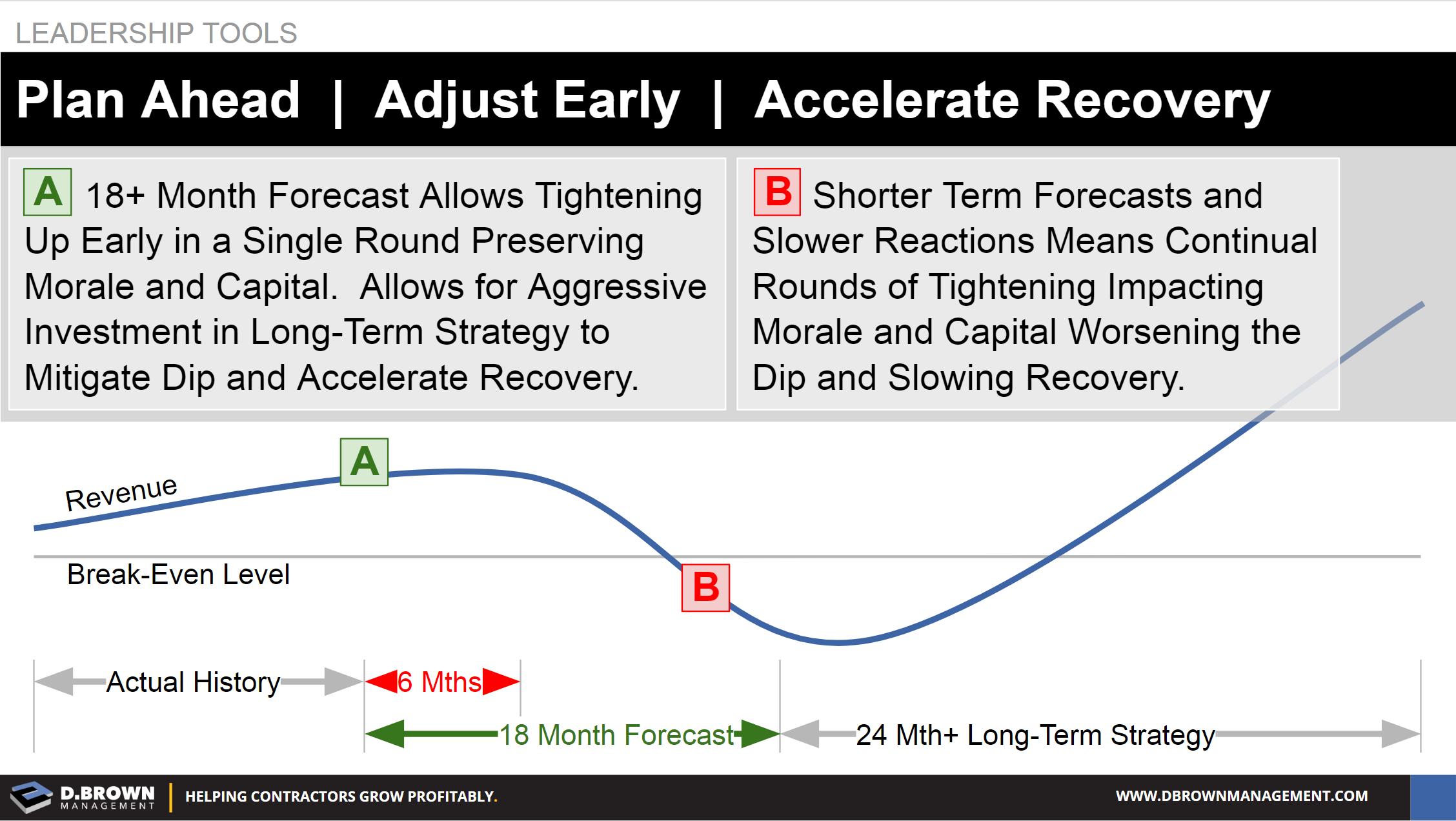
Plan Ahead, Adjust Early, and Accelerate Recovery

Construction in any given industry sector or geographical area is a cyclical business.

D. Brown Management Profile Picture
Share
Leadership Tools: Plan ahead, adjust early, and accelerate recovery.

There are four major levers a contractor can pull to ensure the business performs well throughout all economic cycles. 

  1. Diversifying across several counter-cyclical industry sectors and/or geographies.  
  2. Focus on cross-training core team members so they are agile enough to move between types of projects and even geographies as the market changes.  
  3. Develop aggressive and effective business development capabilities to be able to swim upstream like a salmon.  
  4. Build strong forecasting capabilities to be able to see a market softening well in advance and to act upon that quickly.  

Developing the people, processes, tools and discipline required to forecast out 18-24 months always makes teams stronger.  Exercising teams to really think through what would happen if either their business doubled or halved in the next 18-24 months it makes them more prepared for either. 


Schedule a meeting with our team to learn more about how we help contractors accelerate profitable growth  


Resource - 2 Second Lean
Dozens of practical and fun ways to save a few more seconds each day. 3 minutes per day of additional productive time on tools (ToT) equals about a 1% labor savings - or $10K for every $1M in job cost labor. Helps develop a continuous improvement culture.
The Contractor Scoreboard - A Contractor Must Do 3 Things
This outcome-based scoreboard keeps everyone focused on what matters. Avoid metric overload and diffusion of resources. All other metrics throughout all levels of the organization fall into a hierarchy below these with priorities changing over time.
Governance Structures Enabling Ownership Transitions
Governance structures including the board of directors, policies, information flow, operating rhythm, and decision rights must continually evolve through each stage of growth and ownership transition. The first board is typically driven by a transition.