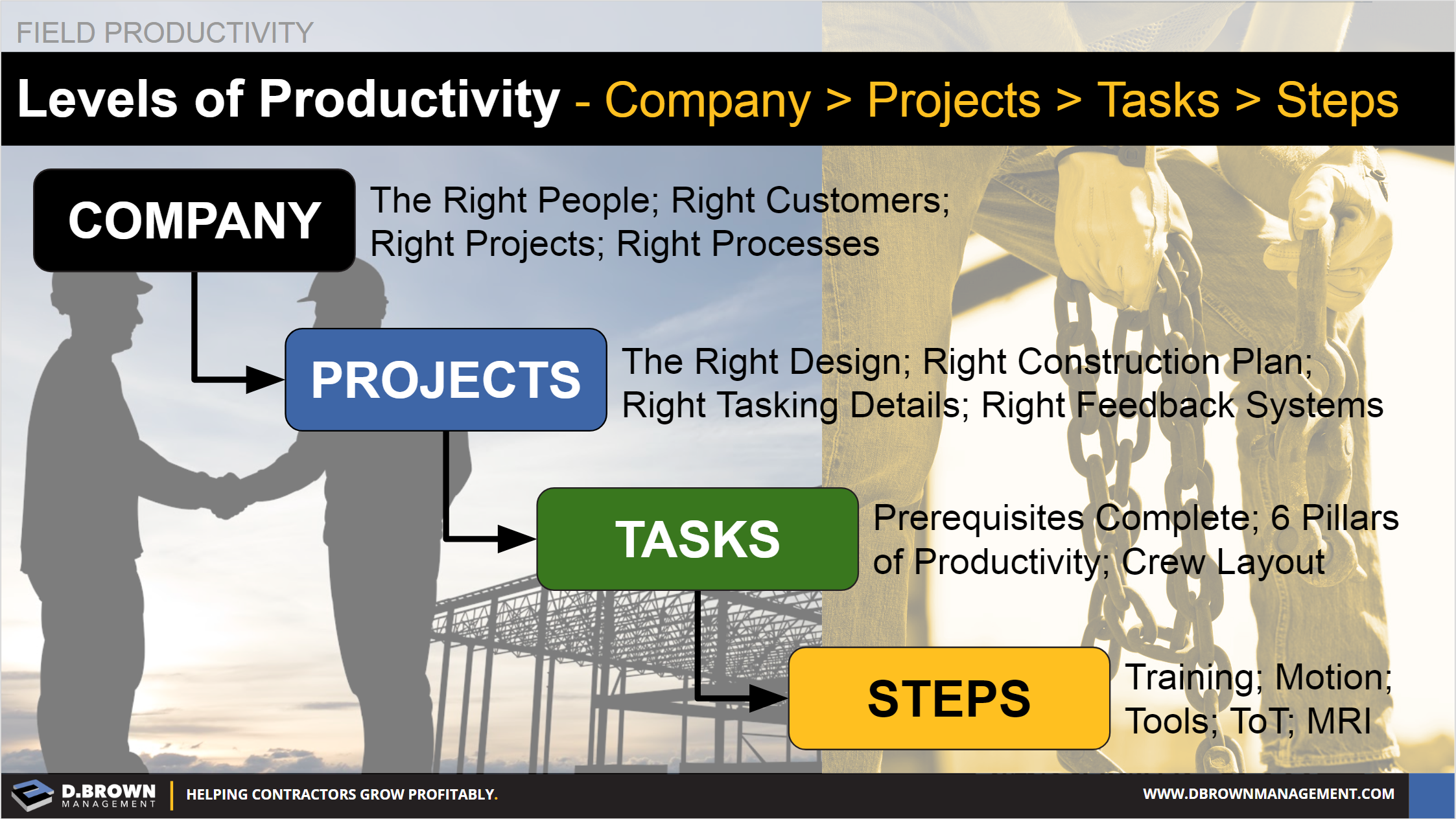
Levels of Productivity

Making major improvements to labor productivity for contractors starts at the company level and must be rigorously managed all the way down to the individual steps in each task.

D. Brown Management Profile Picture
Share
Levels Of Productivity Company, Projects, Tasks, and Steps

We too often see contractors attacking the problem only at one level and not looking at the entire value stream identifying what adds the most value and what does not.  

  • Company - Do you have the right people in place to identify and eliminate waste?  Does your market strategy and opportunity selection process provide projects where you have the best chance of success?
  • Projects - How effective is your planning process?
  • Tasks - What percentage of your tasks have all 6 Pillars of Productivity met before starting?  
  • Steps - Look at every detail, every screw, every step and see if you can eliminate it.  

Remember that the actual speed of the crafts people installing things IS NOT the biggest problem with productivity.


Workshop


Levels of Productivity
Field labor is the often the biggest variable on a construction project - making it the biggest risk and opportunity....

Levels of Productivity
Field labor is the often the biggest variable on a construction project - making it the biggest risk and opportunity....

Resource - 2 Second Lean
Dozens of practical and fun ways to save a few more seconds each day. 3 minutes per day of additional productive time on tools (ToT) equals about a 1% labor savings - or $10K for every $1M in job cost labor. Helps develop a continuous improvement culture.
Types of Trust - Breaking it Down to Build Effective Teams
Build your career, team, project, and company faster by learning to quickly develop trust, including being able to troubleshoot problems. Trust is a very broad term and too often misunderstood. Trust is a verb much more than a noun.
Integrated Safety, Quality, and Production
Integrated safety, quality, and production improve all outcomes with growth. Silos force functions to fight over a “fixed pie,” driving trade-offs.